
The Coffee Cup Dashboard Warning Light Explained
That tiny steaming cup on your instrument cluster is one of the most misunderstood symbols in modern cars - and one of the most important.
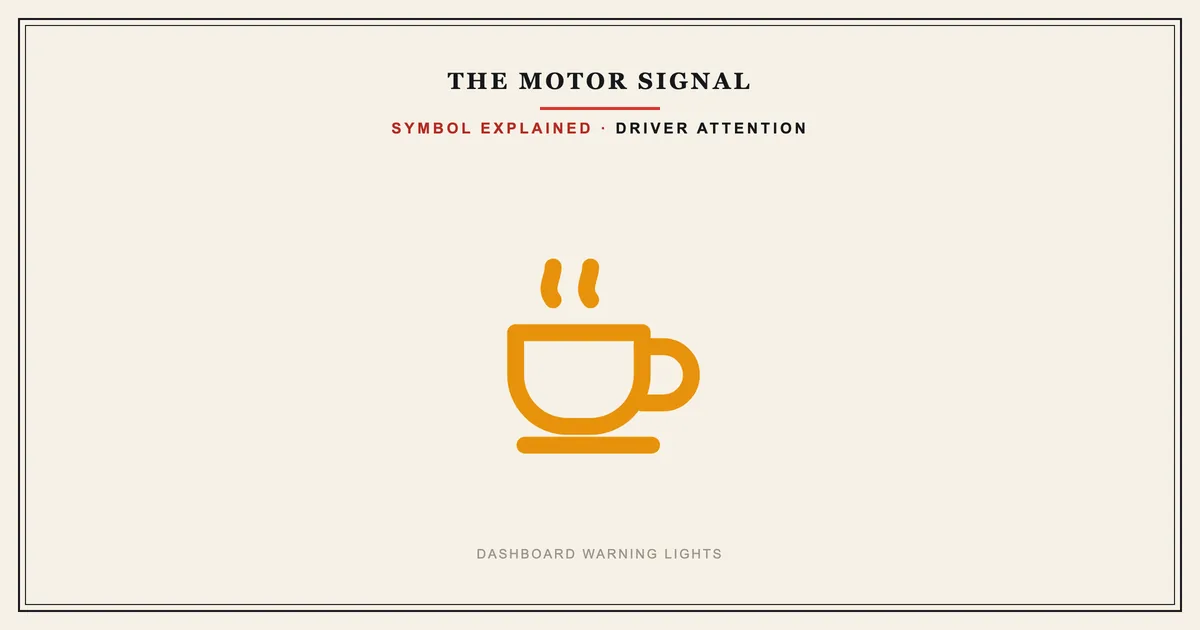
What the coffee cup symbol means
The coffee cup icon on your dashboard is a driver drowsiness or attention warning. When it appears - usually in amber, sometimes accompanied by text like "Take a break" or "Consider resting" - your car is telling you that it has detected signs of fatigue in the way you are driving.
It has nothing to do with the engine, transmission, or any mechanical system. No fluid is low. Nothing is broken. The car is, in effect, playing the role of a concerned passenger who has noticed your driving becoming less sharp.
The symbol itself is deliberately low-key: a steaming cup of coffee, the universal shorthand for "wake up." Some manufacturers pair it with an audible chime and a vibration in the seat or steering wheel to make sure you actually notice it.
Why the coffee cup light comes on
Modern cars monitor your driving behavior continuously. The systems that trigger this warning - known variously as Driver Attention Assist, Driver Alert Control, or Driver Drowsiness Warning depending on the brand - typically track three things: your steering inputs, your lane-keeping behavior, and how long you have been driving.
In the first few minutes of a journey, the system builds a baseline profile of how you normally steer. From that point on, it watches for deviations: small overcorrections, micro-drifts toward lane markings, irregular steering patterns that differ from your own baseline. These are patterns that research has linked to driver fatigue.
Mercedes-Benz's ATTENTION ASSIST, one of the earliest and most sophisticated versions, analyzes more than 70 parameters and factors in external conditions like crosswinds and road surface before deciding whether your steering is genuinely becoming erratic.
The alert also has a time dimension. On long motorway or highway runs, many systems will suggest a break after roughly two to three hours regardless of how alert your steering appears - because the research on sustained highway driving and fatigue is clear.
Is it a fault you need to fix?
No. There is no fault code, no failed component, and nothing to repair. The coffee cup light is a safety prompt generated by a software system - the same category as a seatbelt reminder or a low-fuel alert.
It cannot damage your car if you ignore it, but ignoring it can damage you. Drowsy driving is responsible for a significant share of serious road accidents. The systems that produce this warning exist precisely because drivers are notoriously bad at self-assessing their own level of fatigue.
If the light appears and you genuinely feel alert, it may simply mean you have been making small steering adjustments the system has flagged - perhaps on a winding road, in crosswinds, or after a long uninterrupted stint behind the wheel. A brief stop will reset the system regardless.
If the light keeps returning shortly after you dismiss it, treat that as meaningful data about your condition.
What to do when you see it
The recommended action is straightforward: find a safe place to stop, turn the engine off, and rest for at least 15 to 20 minutes. A short nap in a motorway service area is far more effective than a coffee, despite the irony of the symbol.
Once you restart the car after a break, the system resets automatically in most vehicles - the warning clears and the baseline profile begins fresh. On some models (Kia and Hyundai, for example) you can also dismiss individual alerts using the OK button on the steering wheel or through the driver assistance settings menu, though this does not turn the system off permanently on newer EU-spec vehicles.
From 2024, EU regulations require all new cars to include driver drowsiness detection, and many of those systems cannot be fully disabled - they are treated as a mandated safety feature, similar to ESC.
If you simply need to clear the visual alert for a moment, pressing OK or the relevant menu button on your steering wheel will typically dismiss the current notification. But the system will alert again if it continues to detect the same patterns.
Which cars use the coffee cup warning
Mercedes-Benz was among the first to commercialize this technology with ATTENTION ASSIST, introduced in 2009 on the E-Class. The system has since been standard across the range. The coffee cup icon appears in the instrument cluster with "ATTENTION ASSIST Take a break" text.
Volvo introduced Driver Alert Control (DAC) early and uses a coffee cup combined with a warning chime and, on some models, a haptic seat vibration. The system is tied to Lane Keeping Aid sensors.
Ford offers the Driver Alert System on many models across Europe and increasingly in North America. It uses lane-monitoring data and alerts via a coffee cup symbol with an audible tone.
Volkswagen Group - covering VW, Audi, Skoda, and SEAT - uses a fatigue detection system that presents a yellow coffee cup and chime at a Level 1 alert, escalating if the driver does not respond.
Hyundai and Kia refer to their system as Driver Attention Warning (DAW) or Driver Attention Alert (DAA). It debuted in the Kia Stinger and Hyundai i30 around 2017-2018 and has since spread across both ranges. Their coffee cup icon is accompanied by "Take a break" text on the cluster.
Honda and Acura include a fatigue-monitoring alert on models equipped with Honda Sensing, where the coffee cup or steering-wheel symbol appears when the system detects erratic inputs over time.
Toyota and Lexus include drowsiness detection on higher trim levels and in vehicles with Toyota Safety Sense 3.0, where a coffee cup or break reminder can appear after extended driving periods.
The symbol and exact behavior vary slightly by manufacturer, but the meaning is consistent across all of them: the car has noticed something in your driving and is asking you to rest.
Your questions answered
Is the coffee cup warning light a serious problem?
No. It is not a mechanical fault and does not indicate anything is wrong with your car. It is a safety prompt from the driver attention monitoring system, similar to a seatbelt reminder. The correct response is to take a break, not to visit a garage.
How do I turn off the coffee cup symbol?
In most cars, the alert clears automatically when you stop, turn off the engine, and restart after resting. You can dismiss the current notification by pressing OK or a menu button on your steering wheel. Some brands (Kia, Hyundai, VW) let you adjust sensitivity or disable alerts via the driver assistance settings menu, but on 2024 and newer EU-spec vehicles the system may be mandatory and cannot be fully turned off.
Why is a coffee cup appearing when I am not tired?
The system monitors steering patterns, not how you feel. If you have been driving for a long time, driving on a winding road, or making many small corrections due to crosswinds or traffic, the algorithm may flag your inputs even if you feel alert. A short stop will reset the baseline. If it keeps returning quickly, consider whether you may be more fatigued than you realize.
Does the coffee cup light mean I need to add a fluid or top something up?
No. The coffee cup icon has no connection to any fluid level, engine function, or physical component. It is purely a driver behavior monitoring alert. Do not look under the bonnet for a fix - just find a safe place to pull over and rest.